The challenge: Complex administration and a reactive approach
Before Perstorp Municipality started using the platform, it relied on an older system that did not give HR and managers the control and overview they needed. Managers lacked clear signals for when action was required, and rehabilitation assessments were often inadequate. As a result, sickness absence increased and the organisation’s approach became reactive and inefficient. “We needed something that could give both managers and employees better insight into and control over the rehabilitation process. The old system was not intuitive enough, and we often found ourselves taking action when it was already too late”, says Natalie Lindqvist, Head of HR at Perstorp Municipality.
The solution: An employee-driven platform that simplifies the process
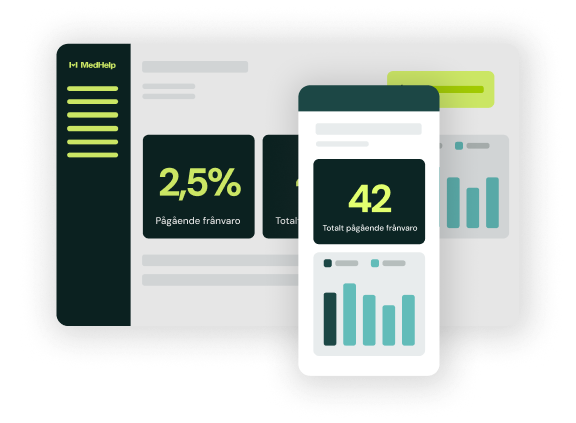
When Perstorp implemented the platform, it fundamentally changed the way the municipality worked. The platform gave HR and managers a clear overview of sickness absence and the actions required, while employees became more involved in their own rehabilitation process. “One of the biggest advantages of the platform is that employees have control over their own data. They can upload their own medical certificates, keep track of their absence and play a more active role in the sickness absence process. This means both managers and employees are better prepared and better informed”, Natalie explains. Managers receive automatic notifications when action is needed, making it easier to keep track of the entire rehabilitation process and take a more proactive approach. “Previously, managers would often wait for the next medical certificate. Now they receive clear signals about what needs to be done and when. This allows them to act sooner and work in a more structured way, helping employees return to work sooner”, says Natalie Lindqvist.
Better collaboration with occupational health services
Another important benefit of the platform has been improved collaboration with occupational health services. Previously, occupational health services were often involved too late in the process, limiting their ability to provide effective support. With MedHelp’s platform, HR and managers can now involve occupational health services earlier and in a more systematic way. “Previously, our approach was more reactive, and occupational health services sometimes became involved only after a case had been going on for some time. Now we can identify early signs of ill health and involve occupational health services much earlier in the process. This allows us to work more preventively and give employees the support they need before problems become more serious”, Natalie explains. This has resulted in faster and more effective rehabilitation measures, helping employees return to work sooner while also reducing the risk of long-term sick leave.
Tangible results: Lower sickness absence and reduced costs
In less than a year, Perstorp reduced its overall sickness absence rate from 6.1% to 5.0%. The largest reduction was seen within social services and education, where sickness absence fell by almost 2 percentage points. “Our sickness absence used to be relatively high, but we are now at around 5%. The biggest reductions have been in the areas that previously had the highest levels of absence, such as social services and schools”, says Natalie Lindqvist.
More efficient management of temporary staff and overtime
Another significant benefit has been the municipality’s ability to optimise its use of temporary staff and reduce overtime. Previously, inefficient staffing processes resulted in high costs and unnecessary overtime for existing employees. The municipality now has a real-time overview of absence, allowing it to plan and deploy temporary staff more strategically. “We have been able to reduce both overtime costs and our need for temporary staff. When we can see exactly what absence looks like from day to day, we can quickly bring in temporary staff where they are actually needed and avoid putting too much pressure on existing employees. It has made an enormous difference, both financially and for the work environment”, Natalie explains. In total, Perstorp Municipality has reduced its costs for fixed-term and temporary staff by SEK 6 million compared with the previous year.
Long-term effects: A better work environment and a stronger foundation for the future
Perstorp’s work has not only delivered immediate improvements but has also created a foundation for a more long-term approach to sickness absence and rehabilitation. For example, the municipality has halved its accrued holiday pay liability through a more structured way of working, while employees have also been given better opportunities for recovery. The number of sickness absence days has fallen by 7,000 compared with the previous year. “We are seeing a major improvement in the work environment. This way of working does not just reduce costs – it also reduces the impact of ill health on our employees. The platform delivers benefits in both the short and long term”, says Natalie Lindqvist.
Looking ahead
Perstorp plans to continue using the platform to build on the progress it has already made. The aim is to reduce sickness absence further and strengthen the work environment by continuing to take a proactive and structured approach to rehabilitation and sickness absence management. “The system has given us a completely different level of control over sickness absence and rehabilitation. It is employee-driven and enables both managers and employees to work smarter and more proactively”, Natalie Lindqvist concludes.
5 reasons the platform has made a difference for Perstorp
- Employee involvement: Employees are more involved in managing their own sickness absence, increasing both engagement and responsibility.
- Automated reminders: Managers and HR receive clear notifications about what needs to be done and when.
- Reduced need for temporary staff: More effective workforce planning and deployment of temporary staff have significantly reduced costs.
- Structured rehabilitation: Managers receive support throughout the rehabilitation process, helping employees return to work sooner.
- Better collaboration with occupational health services: Earlier involvement of occupational health services enables faster and more effective rehabilitation measures.